Against All Enemies: Inside America's War on Terror by Richard A. Clarke
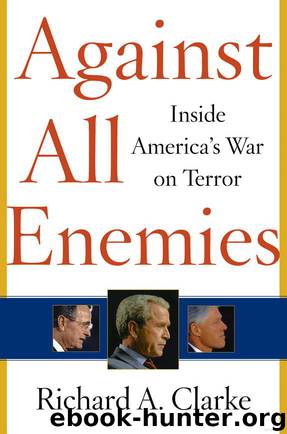
Author:Richard A. Clarke [Clarke, Richard A.]
Language: eng
Format: epub
Tags: American Government, Executive Branch, United States, 21st Century, Political Science, Security (National & International), Terrorism, History
ISBN: 9780743260459
Google: 4X8uAQAAIAAJ
Amazon: 0743260457
Publisher: Free Press
Published: 2004-02-15T00:00:00+00:00
DURING HIS FIRST FOUR YEARS IN SUDAN, bin Laden had kept in the shadows, not overtly confronting the U.S. There were signs in 1995 of his money and support in Bosnia, Chechnya, the Philippines, Egypt, Morocco, and in Europe. Rumors connected him to attacks in New York, Somalia, Saudi Arabia, and Yemen. But they were only rumors. He might know Khalid Sheik Muhammad, who might be the uncle of Ramzi Yousef, who attacked the World Trade Center in 1993 and had tried to attack 747s over the Pacific. Perhaps one of bin Laden’s brothers-in-law, Muhammad Jamal Khalifa, moved money to terrorist groups like the bag carrier in the 1950s television show The Millionaire. (In January 1995, Khalifa was detained by U.S. Customs at San Francisco International. Jim Reynolds at the Justice Department tried hard, at my request, to find grounds to indict Khalifa in connection with the World Trade Center attack or any other crime. Unfortunately, the Justice Department could not generate an indictment and Khalifa was extradited to Jordan, where he was subsequently released for lack of evidence there too.)
In the summer of 1995, bin Laden had written a public letter to Saudi King Fahd, denouncing the U.S. troop presence. CIA, under White House pressure and with the support of staff in its Counterterrorism Center, began to develop plans for a station dedicated to investigating what they now agreed was a “bin Laden network.” Not wanting to risk putting the station in Khartoum, where bin Laden was, they began to develop a proposal for an innovation, a “virtual station.” The virtual station would be structured like an overseas office. Physically, it would not even be in CIA headquarters.
Then in the spring of 1996, two chess pieces moved. Bin Laden flew to Afghanistan, closing some of his Khartoum companies and houses. After he left, Jamal al-Fadl, who had been privy to much of the “bin Laden network” based in Sudan, sought U.S. protection. He had been siphoning off funds and feared al Qaeda would kill him. Fadl’s interrogation helped the new virtual station discover the size and shape of the network. What they found was widespread and active, with a presence through affiliate groups or sleeper cells in over fifty countries. Ramzi Yousef and the blind sheik had been part of it. Bin Laden was not just its financier, he was its mastermind.
The network also had a name, we learned: the foundation or base, as in the foundation of a building. Usama bin Laden, son of a building contractor, had called his terrorist network by an Arabic word, al Qaeda. It was the first piece, the necessary base for the edifice that would be a global theocracy, the great Caliphate.
The Taliban welcomed bin Laden enthusiastically back to Afghanistan. He had been funding terrorist training camps there while in Sudan. Fighters caught in Chechnya and Bosnia had been taught at these facilities. Now the camps expanded with new recruits from across the Islamic world. Those who did well graduated either to
Download
This site does not store any files on its server. We only index and link to content provided by other sites. Please contact the content providers to delete copyright contents if any and email us, we'll remove relevant links or contents immediately.
| Anthropology | Archaeology |
| Philosophy | Politics & Government |
| Social Sciences | Sociology |
| Women's Studies |
The Secret History by Donna Tartt(19480)
The Social Justice Warrior Handbook by Lisa De Pasquale(12301)
Thirteen Reasons Why by Jay Asher(9135)
This Is How You Lose Her by Junot Diaz(7075)
Weapons of Math Destruction by Cathy O'Neil(6488)
Zero to One by Peter Thiel(5956)
Beartown by Fredrik Backman(5954)
The Myth of the Strong Leader by Archie Brown(5633)
The Fire Next Time by James Baldwin(5598)
How Democracies Die by Steven Levitsky & Daniel Ziblatt(5339)
Promise Me, Dad by Joe Biden(5239)
Stone's Rules by Roger Stone(5197)
A Higher Loyalty: Truth, Lies, and Leadership by James Comey(5092)
100 Deadly Skills by Clint Emerson(5034)
Rise and Kill First by Ronen Bergman(4911)
Secrecy World by Jake Bernstein(4899)
The David Icke Guide to the Global Conspiracy (and how to end it) by David Icke(4858)
The Doomsday Machine by Daniel Ellsberg(4633)
The Farm by Tom Rob Smith(4614)
